<?xml version="1.0" encoding="utf-8"?><feed xmlns="http://www.w3.org/2005/Atom" ><generator uri="https://jekyllrb.com/" version="3.10.0">Jekyll</generator><link href="https://ryan-b-amos.com/feed.xml" rel="self" type="application/atom+xml" /><link href="https://ryan-b-amos.com/" rel="alternate" type="text/html" /><updated>2026-04-06T01:15:44+00:00</updated><id>https://ryan-b-amos.com/feed.xml</id><title type="html">Ryan Amos</title><subtitle>My personal website. Check out my work, both personal and professional.</subtitle><entry><title type="html">How blackmithing helped me find my software engineering job; or the TPAAAT isn’t just for anvils</title><link href="https://ryan-b-amos.com/2026/04/05/tpaaat.html" rel="alternate" type="text/html" title="How blackmithing helped me find my software engineering job; or the TPAAAT isn’t just for anvils" /><published>2026-04-05T16:00:00+00:00</published><updated>2026-04-05T16:00:00+00:00</updated><id>https://ryan-b-amos.com/2026/04/05/tpaaat</id><content type="html" xml:base="https://ryan-b-amos.com/2026/04/05/tpaaat.html"><![CDATA[<blockquote>
  <p><strong>SUMMARY</strong>: If you’re looking for a job, or anything really, ask everyone you meet. It’s hard but it’s effective.</p>
</blockquote>

<p>When I was in the latter half of my college years, I started to develop an interest in blacksmithing. I built a home forge, bought a cheap “anvil” (or <a href="https://anvilfire.info/grizzly-anvils-and-chinese-asos/">anvil-shaped object</a>), and became enamored with the craft. Pretty soon, I wanted a real anvil with a hardened steel face. It turns out buying a new, quality anvil was way out of my budget, on the order of thousands of dollars for a good one. So I did a lot of reading, and came across the “<a href="https://www.iforgeiron.com/topic/3602-thomas-powers-applied-anvil-acquisition-technique-tpaaat/">Thomas Powers Applied Anvil Acquisition Technique</a>”.</p>

<p><img src="/photos/tpaaat/aso.jpg" width="45%" title="The ASO" alt="My ASO on a stand" /> <img src="/photos/tpaaat/forge.jpg" width="45%" title="The forge" alt="My homemade forge. Janky looking" /></p>

<h2 id="the-tpaaat">The TPAAAT</h2>
<p>The TPAAAT is really quite simple. Ask <em>everyone</em> you meet about whether they know where you can get an anvil. Seriously, everyone. Reach out to every person you know in your area, ask them if they have an anvil, if their uncle has an anvil, if their friend has an anvil, and if they’d be willing to sell it to you. Talk to every person you meet, even if you don’t know them.</p>

<p>If you are like me, you might think “that sounds horrible, asking people I don’t know for a favor!”. But this is not how human psychology works! Most people <em>love</em> helping others, especially when it takes almost no effort. As long as you’re not pushy (e.g. asking the same people multiple times) or disruptive (e.g. grabbing the microphone during a funeral), people will generally want to help you. Also, from my experience, the question “Do you know where I can buy an anvil?” is so unusual it’s intriguing. Many people want to help you out just because they’ve never met someone who wants to acquire such an archaic thing.</p>

<h2 id="how-i-finally-got-my-first-anvil">How I finally got my first anvil</h2>
<p>Anticlimactically, I bought a Mousehole anvil from a New England Blacksmiths meet in NH, so the TPAAAT did not help me here. What I didn’t realize is that I would use the same strategies I’d practiced for a different kind of acquisition, years later.</p>

<p><img src="/photos/tpaaat/mousehole_anvil.jpg" width="45%" title="The ASO" alt="My ASO on a stand" /></p>

<h2 id="graduating-as-dr-unemployed">Graduating as Dr. Unemployed</h2>
<p>I had just graduated from my PhD program with basically nothing lined up. I figured it would be easier to search for a job when I wasn’t stressed about writing my dissertation and defending[1]. So I graduated, and then it was time to hunt.</p>

<p>Like I’m sure many people do, I pulled up LinkedIn and Indeed and started looking for jobs. And, like I’m sure many people experience, I heard back nothing. This makes some sense, if you think about it – there are probably a handful of jobs that are optimized for these platforms, everyone sees those jobs, everyone applies for them, they get flooded. I have to imagine there’s a long tail of jobs that get very few applications. Ideally what you want is to find that long tail, but how? Those are the jobs that are hard to find on these platforms!</p>

<p>It turns out, referrals are a great way to get noticed. If you’re not familiar with referrals, someone who works at a company can refer a candidate for a role. This is mutually beneficial – referred candidates are usually of a higher quality, partially because the referrer is staking a bit of their reputation on the referral; the referrer helps a contact get a job and often collects a referral bonus; and the referred candidate gets a shot at the job. Win-win-win[2]!</p>

<h2 id="the-tpaaat-again">The TPAAAT, again</h2>

<p>Unfortunately, getting a referral isn’t easy. It turns out TPAAAT isn’t just for anvils. Just swap out “anvil” for anything you’d like. So you want a software engineer (SWE) job? Ask literally everyone. And that’s exactly what I did. I have to admit, it was exhausting for me, but I did my best to stick to the goal of asking everyone I met.</p>

<h2 id="success">Success</h2>
<p>I was at <a href="https://www.rockvilleclimbing.com/">Rockville Climbing Center</a>, bouldering, and I was asking everyone I met if they knew anyone hiring SWEs. Eventually, someone I had just met said (paraphrasing) “Yes, I work at Panorama Education and we’re hiring.”. I got her contact, she referred me, and after a few interviews I got an offer!</p>

<p>Here’s a pretty unrelated video of me climbing in 2021 at Rockville:</p>

<video width="320" height="240" controls="" title="Rockville" alt="The author leading, and falling, at Rockville Climbing Center">
  <source src="/photos/tpaaat/20210727_202151.mp4" type="video/mp4" />
</video>

<p>I had 3 other offers lined up when I accepted the Panorama offer. One was a law firm who was looking for a technology expert; I was referred to that role by a colleague who had interned for them. Another was for a small local company that was recruiting at a local job fair[3]. The last one was a defense contractor I applied to cold on Indeed.</p>

<h2 id="the-takeaway">The takeaway</h2>
<p>If you are on the job market, looking for a job, ask every. single. person. you know and every. single. person. you meet for a lead[4]. You never know who might know someone who knows someone.</p>

<p><a href="https://en.wikipedia.org/wiki/Six_degrees_of_separation">Social distances</a> are <a href="https://ojs.aaai.org/index.php/SOCS/article/download/18200/17991">smaller than we think</a>, and people generally like being helpful. Leverage your network, and remember that networking isn’t about being slimy and self-serving, it’s about making genuine, mutually benefical connections.</p>

<h2 id="footnotes">Footnotes</h2>
<p>[1] Of course, it’s not called a “defense” at Princeton, because Princeton has to have their own terminology for everything. Instead, it’s a “Final Public Oral Examination” (FPO). Other fun terminology – your qualifying exam is a “General Examination”; for funding you don’t become a teaching assistant (TA) or research, you take on an assistantship in instruction (AI). At least they give out PhDs instead of DPhils.</p>

<p>[2] It would be remiss of me to not mention that referral-heavy filling of roles also results in a “the rich get richer” effect, where people already well connected to those in desireable/prestigious/etc roles are more likely to get them. If you want, for example, a high paying job, it’s much easier to get one if you know lots of people in high paying jobs, possibly through your family. So referrals are also a vehicle for nepotism and limit economic mobility. Note that referrals aren’t a free pass; you still need to pass the interview. My understanding is they get your foot in the door – it’s more likely you’ll get that first interview.</p>

<p>[3] Recruiting ≈ Referrals. Both get your resume looked at. I think recruiters generally have a bit more sway.</p>

<p>[4] Within reason :)</p>]]></content><author><name></name></author><summary type="html"><![CDATA[SUMMARY: If you’re looking for a job, or anything really, ask everyone you meet. It’s hard but it’s effective.]]></summary></entry><entry><title type="html">Open Mic 2024/05/15</title><link href="https://ryan-b-amos.com/music,/covers/2024/05/20/open-mic.html" rel="alternate" type="text/html" title="Open Mic 2024/05/15" /><published>2024-05-20T01:48:00+00:00</published><updated>2024-05-20T01:48:00+00:00</updated><id>https://ryan-b-amos.com/music,/covers/2024/05/20/open-mic</id><content type="html" xml:base="https://ryan-b-amos.com/music,/covers/2024/05/20/open-mic.html"><![CDATA[<iframe width="560" height="315" src="https://www.youtube.com/embed/DYPxAeeEEqU?si=IWMDJvw4GXwQk19Y" title="YouTube video player" frameborder="0" allow="accelerometer; autoplay; clipboard-write; encrypted-media; gyroscope; picture-in-picture; web-share" referrerpolicy="strict-origin-when-cross-origin" allowfullscreen=""></iframe>

<p>My first open mic! A huge thanks to everyone who came out to support us, and to Pino’s and Tommy for hosting the event.</p>]]></content><author><name></name></author><category term="music," /><category term="covers" /><summary type="html"><![CDATA[]]></summary></entry><entry><title type="html">Supposed to rot</title><link href="https://ryan-b-amos.com/music,/covers/2024/05/12/supposed-to-rot.html" rel="alternate" type="text/html" title="Supposed to rot" /><published>2024-05-12T15:29:00+00:00</published><updated>2024-05-12T15:29:00+00:00</updated><id>https://ryan-b-amos.com/music,/covers/2024/05/12/supposed-to-rot</id><content type="html" xml:base="https://ryan-b-amos.com/music,/covers/2024/05/12/supposed-to-rot.html"><![CDATA[<iframe width="560" height="315" src="https://www.youtube-nocookie.com/embed/KVK3Xs1eAUo?si=4rWW_RgfQql14wr5" title="YouTube video player" frameborder="0" allow="accelerometer; autoplay; clipboard-write; encrypted-media; gyroscope; picture-in-picture; web-share" referrerpolicy="strict-origin-when-cross-origin" allowfullscreen=""></iframe>

<h2 id="the-song">The song</h2>

<p>I first encountered this song in March 2024, and I decided to start working on learning it at the very end of October. If you’re not familiar with <a href="https://en.wikipedia.org/wiki/Entombed_(band)">Entombed</a>, they’re a genre-defining Swedish death metal band. They released this song when they were just 17 years old (!); I’m not sure what you were doing at 17, but I certainly wasn’t pushing the frontiers of music.</p>

<p>I learned the song pretty quickly; it’s really <a href="https://www.songsterr.com/a/wsa/entombed-supposed-to-rot-tab-s417712">not that complicated</a>, mostly just tremolo and a few power chords and chugs. But wow is it fast! I put the song down and came back to it every so often as I worked on other songs.</p>

<p>I finally eventually hit a breakthrough after shifting gears, and found myself able to play 16th note tremolo at 180bpm, then 190, then 195, etc. slowly creeping up to the 220bpm needed for this song. Among other things, I had to learn some new tricks for tremolo picking: hold the pick at a 45 degree angle, perpendicular to the plane of the strings, barely touch the strings (let the cranked gain do the work), toss your pick as soon as it dulls any, minimize all movements. I also swapped to top light bottom heavy strings since the floppiness was a challenge to deal with.</p>

<h2 id="recording">Recording</h2>

<p>I stripped out the guitar tracks using <a href="https://vocalremover.org/splitter-ai">this web tool</a>, which I’m pretty sure is just running <a href="https://github.com/adefossez/demucs">this open-source tool</a> on the backend. Sadly it didn’t get that dive-bomb harmonic out, but also I don’t have a guitar with a whammy bar so maybe it’s for the best.</p>

<p>Then I recorded everything in Ableton roughly following this quote fromUffe Cederlund in a <a href="https://reverb.com/news/story-hm2-dark-side-boss">Reverb Interview</a>:</p>

<blockquote>
  <p>I just used a worthless Ibanez guitar, a small Peavey combo amplifier, and a Boss Heavy Metal pedal. Basically, there are two Boss Heavy Metal-distorted guitars – one in each speaker – and a DS-1 in the middle.</p>
</blockquote>

<p>I used <a href="https://www.bluecataudio.com/Products/Product_FreeAmp/">Blue Cat’s Free Amp</a> on Modern Drive, with significantly boosted Bass, Treble, and Drive on the left and right guitars, and I backed off all 3 on the middle guitar. Each playthrough was a single take, but many takes were requried. I mixed that with the guitar-less track and got the audio you hear above.</p>

<p>Then I recorded a video of a fourth playthrough, removed the audio and subbed in my track. If the video doesn’t line up with what you’re hearing, that’s why – the video is just for show. But doesn’t it look way more rad with the video than just a blank screen or a static image?</p>]]></content><author><name></name></author><category term="music," /><category term="covers" /><summary type="html"><![CDATA[]]></summary></entry><entry><title type="html">HM-2 Build</title><link href="https://ryan-b-amos.com/2024/05/12/hm-2.html" rel="alternate" type="text/html" title="HM-2 Build" /><published>2024-05-12T13:52:00+00:00</published><updated>2024-05-12T13:52:00+00:00</updated><id>https://ryan-b-amos.com/2024/05/12/hm-2</id><content type="html" xml:base="https://ryan-b-amos.com/2024/05/12/hm-2.html"><![CDATA[<h1 id="why-build-an-hm-2">Why build an HM-2?</h1>
<p>After finishing my cover of Supposed to Rot (<a href="https://www.youtube.com/watch?v=IxMnWiIvPrQ&amp;pp=ygUPc3VwcG9zZWQgdG8gcm90">Original</a>) (<a href="https://www.youtube.com/watch?v=KVK3Xs1eAUo">My cover</a>):</p>

<iframe width="560" height="315" src="https://www.youtube-nocookie.com/embed/KVK3Xs1eAUo?si=0OSxtiZXiQS7Utg7" title="YouTube video player" frameborder="0" allow="accelerometer; autoplay; clipboard-write; encrypted-media; gyroscope; picture-in-picture; web-share" referrerpolicy="strict-origin-when-cross-origin" allowfullscreen=""></iframe>

<p>I got pretty interested in the guitar pedal made famous by this album, and this genre more generally, the <a href="https://en.wikipedia.org/wiki/Boss_HM-2">Boss HM-2</a>. These pedals only really gained fame after manufacturing stopped, leading to the perfect conditions for scarcity. Fortunately, getting one of these pedals isn’t too hard today with many clones on the market and the HM-2X Waza Craft re-release by Boss.</p>

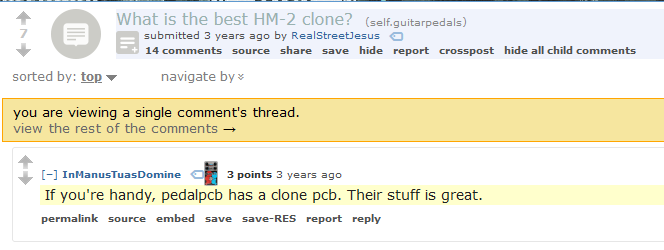
<p>I was looking at suggestions for an HM-2 clone, and I stumbled across <a href="https://www.reddit.com/r/guitarpedals/comments/iygqo4/what_is_the_best_hm2_clone/g6culu5/">this comment</a> that sent me down a rabbit hole: (Thanks /u/InManusTuasDomine!)
<img src="/photos/hm-2/reddit-post.png" alt="If you're handy, pedalpcb has a clone pcb. Their stuff is great." /></p>

<p>I’ve got a bit of electronics experience, but I’d never done anything quite like this before. I find cautiously diving headfirst to be a great way to learn, so off I went.</p>

<h2 id="sourcing-the-parts">Sourcing the parts</h2>
<p>I sourced parts from 3 online stores:</p>
<ul>
  <li><a href="https://www.pedalpcb.com/">PedalPCB</a> (obviously)</li>
  <li><a href="https://www.taydaelectronics.com/">Tayda</a></li>
  <li><a href="https://stompboxparts.com/">StompBoxParts</a></li>
</ul>

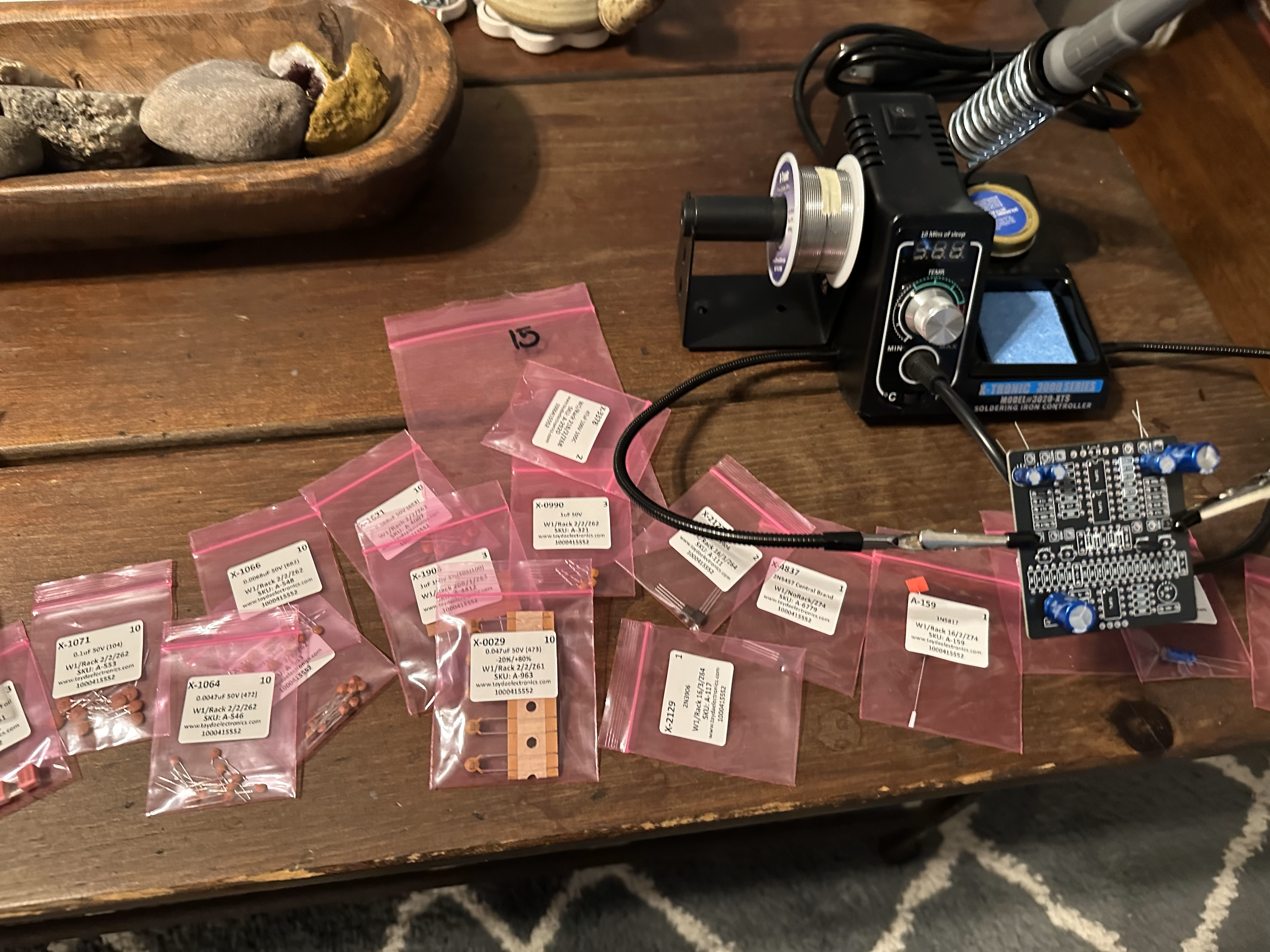
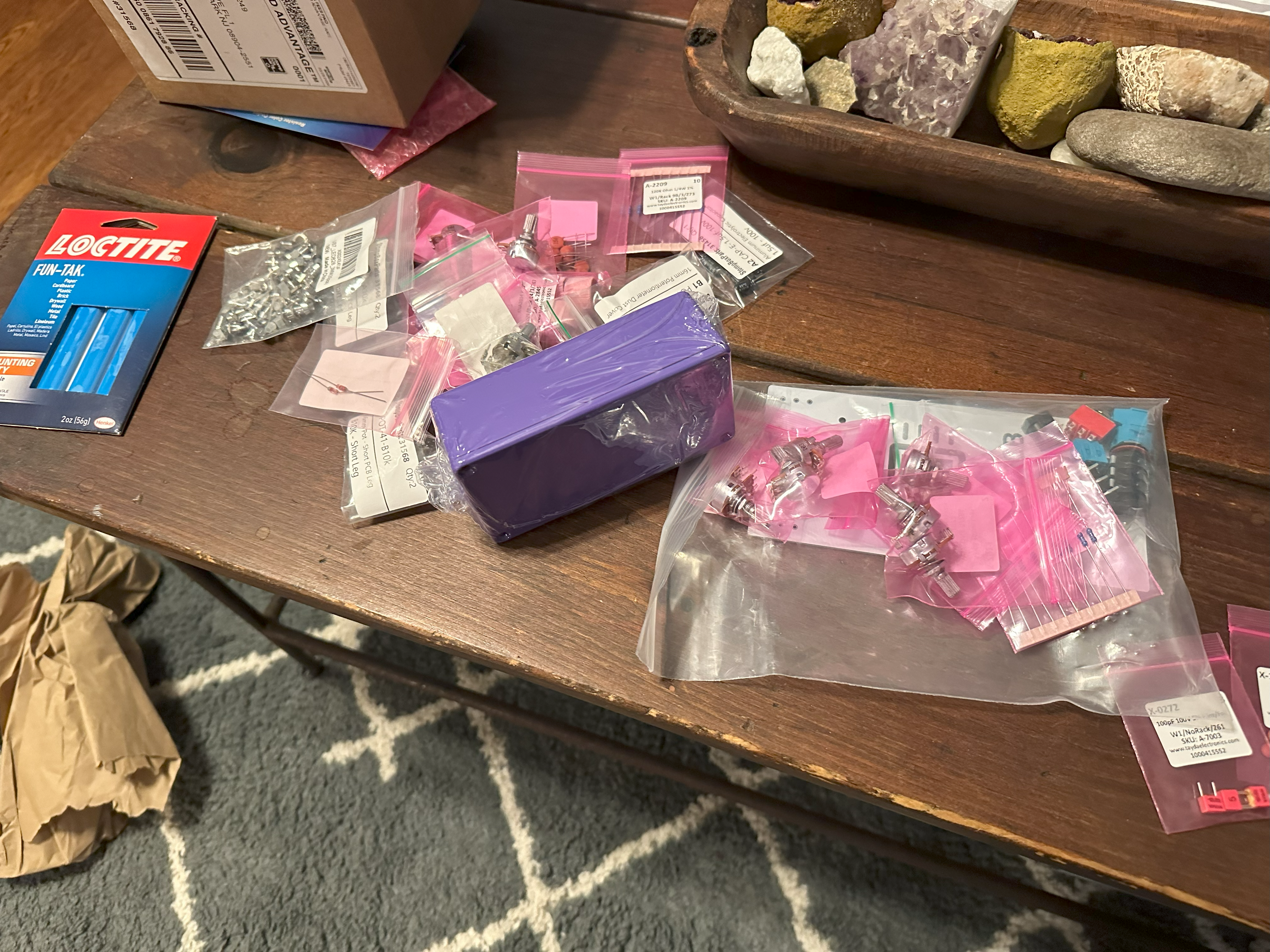
<p>PedalPCB provided the PCB and the op-amps. Tayda provided the bulk of the electronics and the housing (pre-drilled and painted). StompBoxParts provided some of the more unusual parts, like Germanium diodes. I purchased ceramic capacitors – in hindsight, I was warned not to, but in the flood of information I missed/misunderstood that warning. Everything turned out okay, but I wouldn’t do it again!</p>

<p><img src="/photos/hm-2/parts-1.png" alt="Assorted parts" /></p>

<p><img src="/photos/hm-2/parts-2.png" alt="Assorted parts 2" /></p>

<p>I also treated myself to a new soldering iron. My 12 year old, $10 Radio Shack one takes forever to heat up, then burns everything it touches.</p>

<h2 id="pcb-assembly">PCB Assembly</h2>
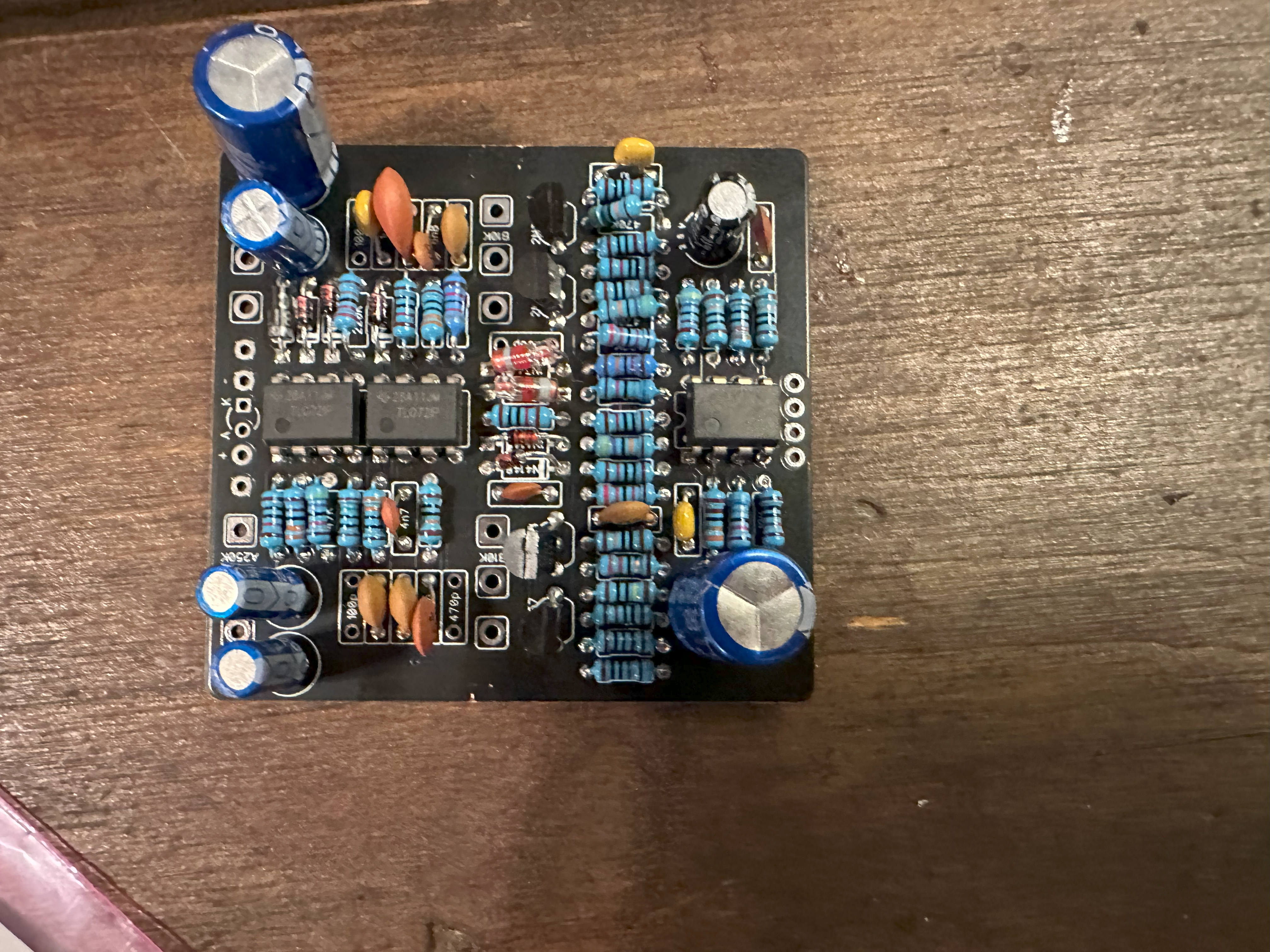
<p>Once I had all of the pieces, I started assembling the parts on the PCB. Pro-tip: bend the leads inwards, not outwards, 
so they don’t short circuit with their neighbors; that’s the opposite of what you see here.</p>

<p><img src="/photos/hm-2/pcb-pre-solder.png" alt="PCB partial completion" /></p>

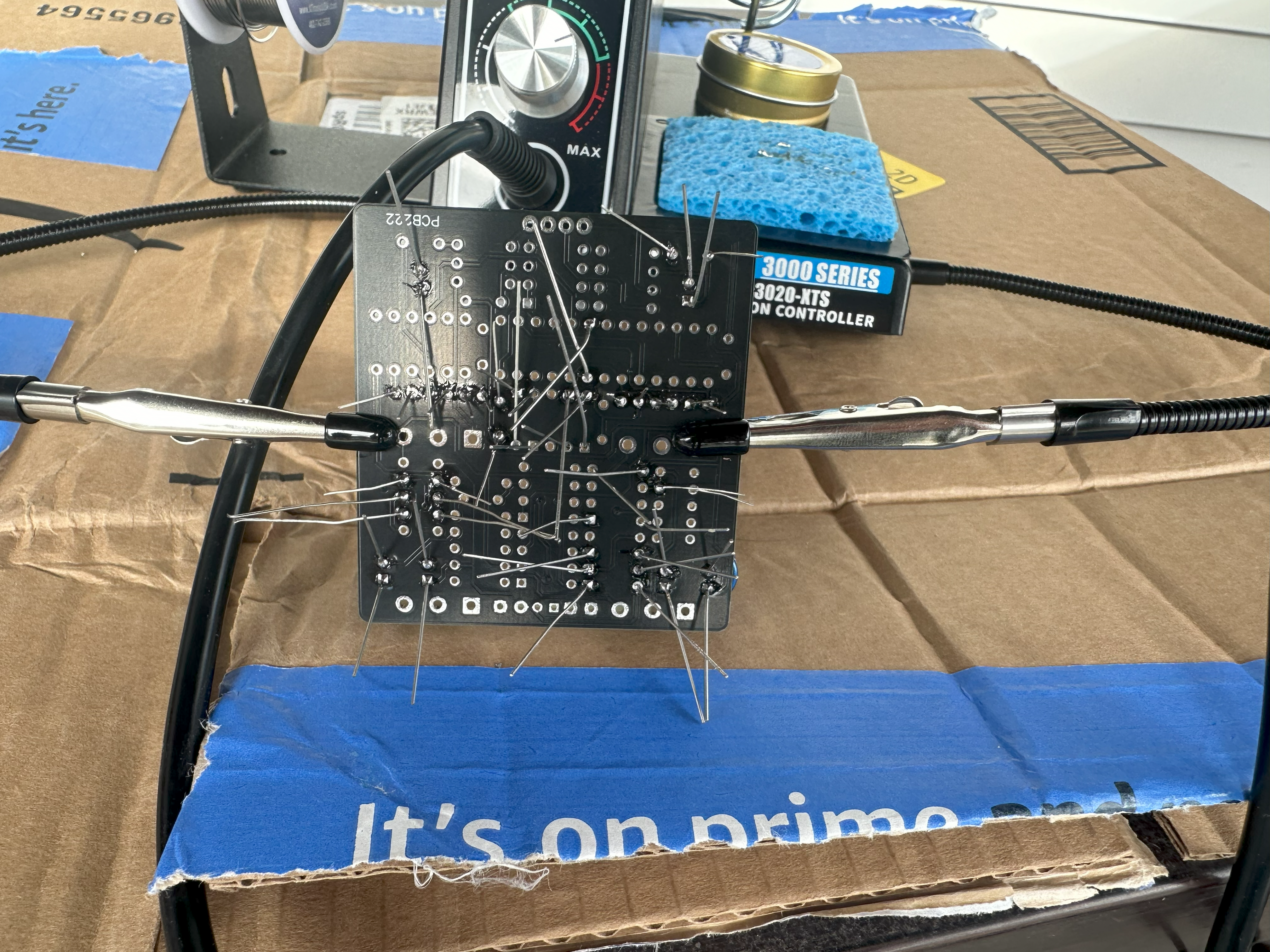
<p>And soldered them.</p>

<p><img src="/photos/hm-2/pcb-soldered.png" alt="PCB after soldering" /></p>

<p>Unfortunately some of the capacitors I bought had the wrong size; the lead spacing was correct but they were too wide and obstructed access. 
You’ll see those missing here.</p>

<p>You’ll notice the potentiometers are also missing. Sadly I purchased every type of potentiometers except the one I actually needed.
 I sent off another order for replacement capacitors and short-leg potentiometers.</p>

<h2 id="housing-assembly">Housing assembly</h2>

<p>I dry fit everything to make sure there wouldn’t be any problems getting everything in the housing</p>

<p><img src="/photos/hm-2/dry-fit.JPG" alt="Dry fit -- the PCB isn't soldered in, but the components are in place" /></p>

<p>Then I alligator clipped everything up and disaster: it sounds like trash!</p>

<h2 id="diagnostics-part-1">Diagnostics part 1</h2>

<p>I hooked everything up to PedalPCB’s Auditorium testing platform (glad I grabbed one!) to eliminate any problems with the external wiring. 
Doing so did indeed eliminate any risk that my housing wiring was the issue.</p>

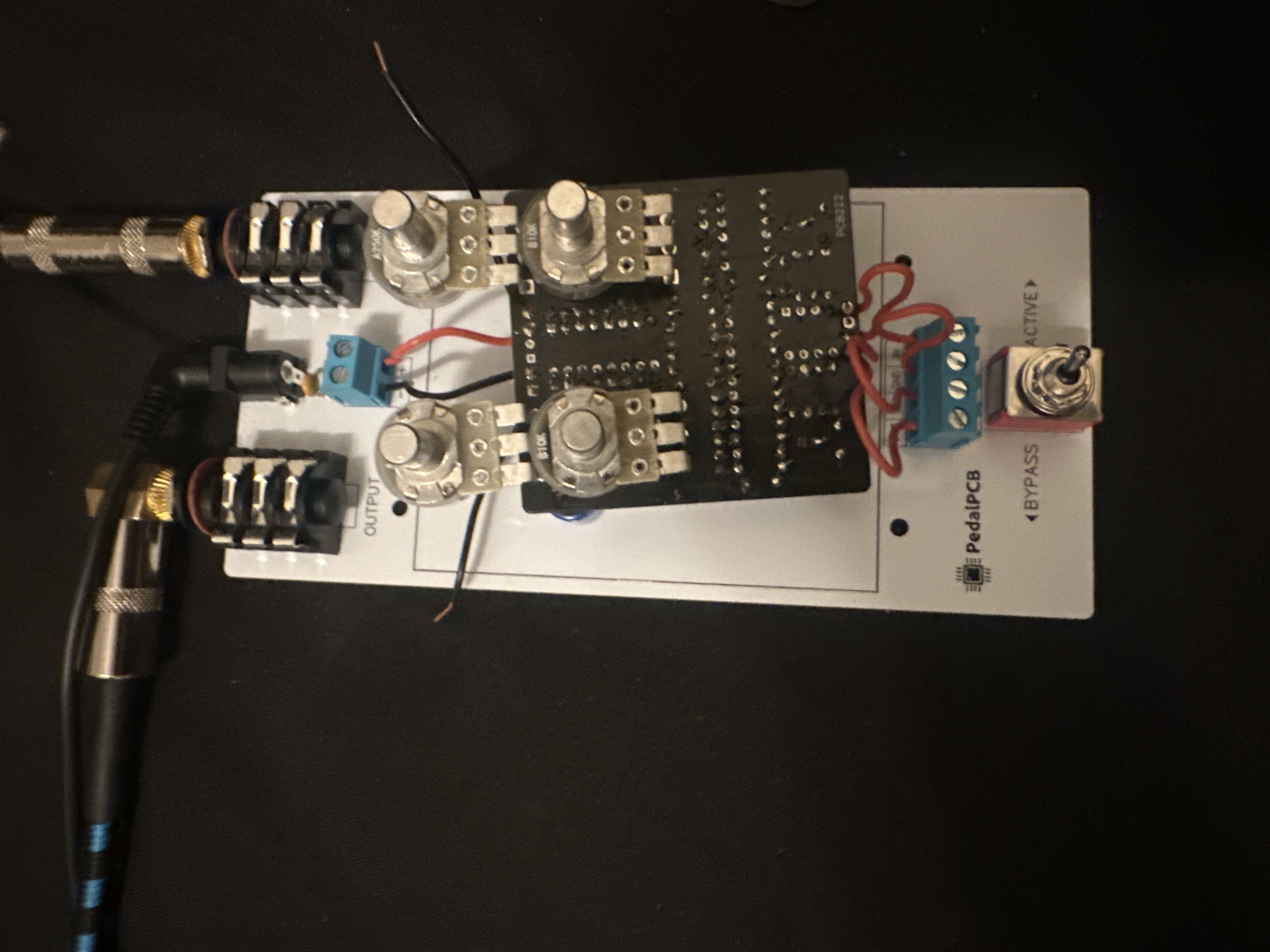
<p><img src="/photos/hm-2/testing.JPG" alt="Testing in the Auditorium" /></p>

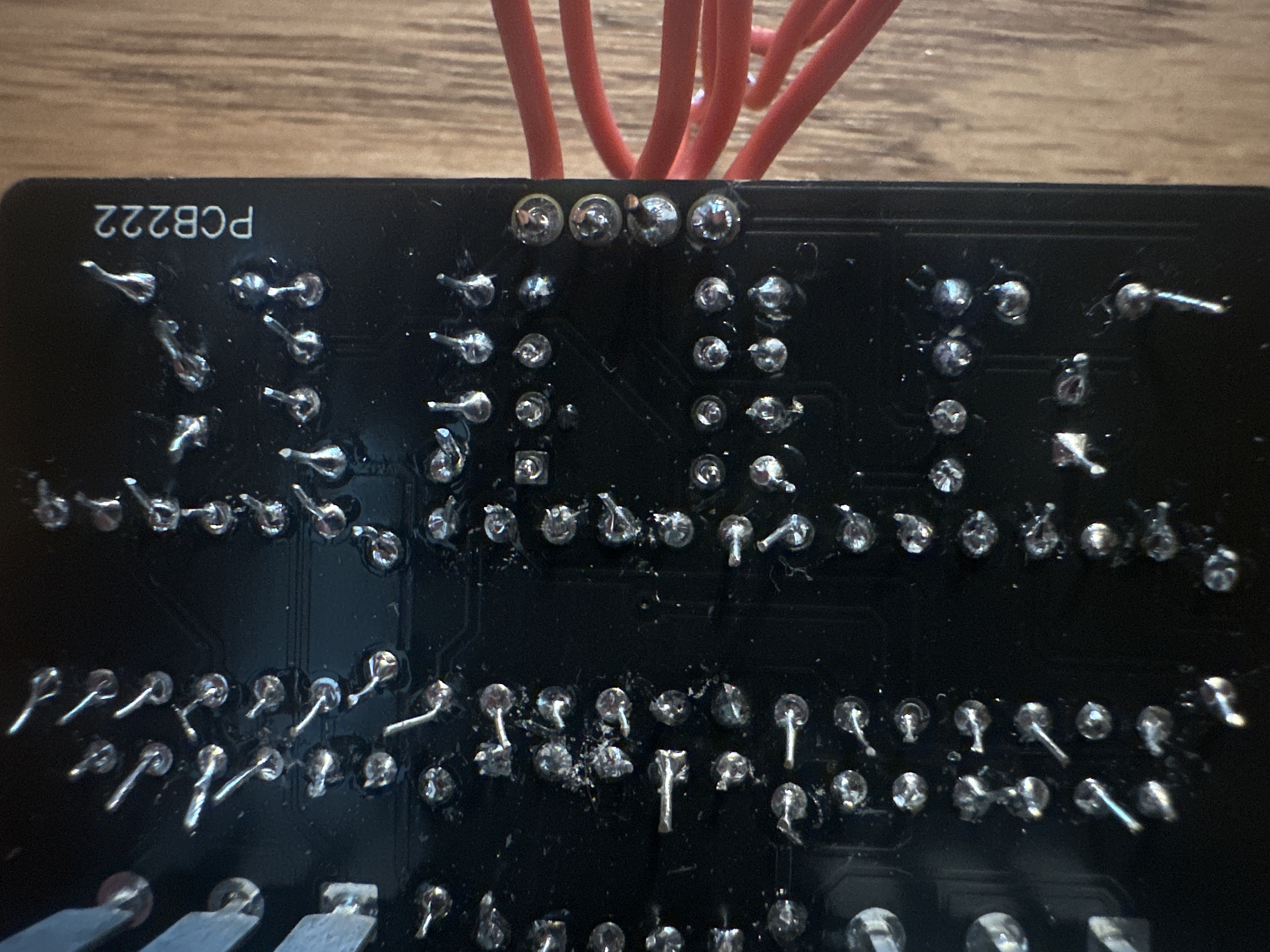
<p>I did a lot of testing. First I touched up these terrible solder joints.</p>

<p><img src="/photos/hm-2/solder-close-up.JPG" alt="My terrible solder joints" /></p>

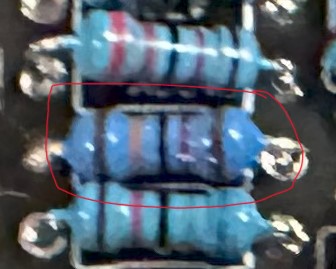
<p>Unfortunately that didn’t solve the problem. Ultimately I went through every single part and checked the values. It turns out that reading resistor and capacitor codings isn’t too difficult and you can get pretty quick at it. Here, at resistor 14, was the problem:</p>

<p><img src="/photos/hm-2/problem.jpg" alt="The problem resistor: Brown, red, black, orange, Brown" /></p>

<p>The colors look a bit weird on the camera, but the colors were brown, red, black, orange, brown – a 120 * 1000 = 120k ohm resistor. That’s not consistent with <a href="https://docs.pedalpcb.com/project/Promethium.pdf">the build docs</a>! Yet another order I sent in to get the correct resistor shipped, and so we wait.</p>

<h2 id="diagnostics-part-2">Diagnostics part 2</h2>

<p>After replacing the bad resistor, I got that sweet, sweet buzzsaw sound out of the pedal Auditorium. It was time to hook it up. I soldered up the external wiring and…</p>

<p>Nothing! What? The LED wouldn’t even turn on. After lots of multimeter shenanigans, I discovered swapping the polarity (positive voltage to the negative terminal) would light up the LED, and then I confirmed this by using a polarity swapping cable and checking the Auditorium’s polarity. Easy fix – just swap the leads coming off the power cable right? Sadly that wasn’t enough; my power jack was grounding the neutral line to the box, so I needed to get a new insulated jack. Yet another shipment required…</p>

<h2 id="decoration">Decoration</h2>

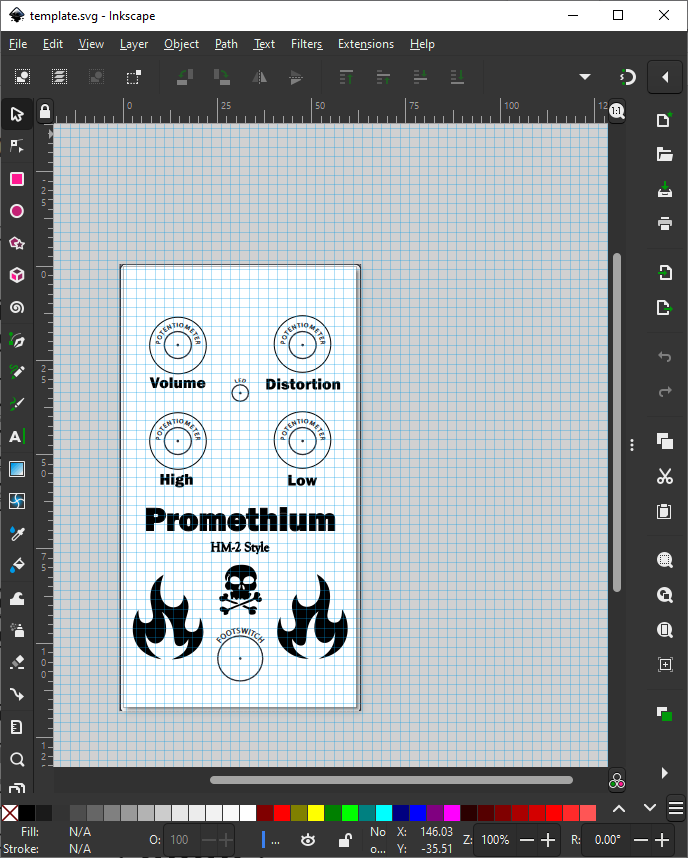
<p>I created a design for the face in Inkscape, laying out some public domain SVG art and text on top of the drill template</p>

<p><img src="/photos/hm-2/sticker.png" alt="The sticker template" /></p>

<p>I sent the design off to get printed as a red vinyl sticker. Sadly, it came in all the wrong dimensions. I wonder if something happened with cropping and resizing during format conversion, either on my end or theirs. Either way, I didn’t want to wait another 2 weeks to finish this project, so I went to my local maker space and printed off the vinyl sticker with their help. This turned out to be way more tricky than I expected; I guess $10 wasn’t really such a bad deal after all.</p>

<h2 id="the-final-product">The final product</h2>

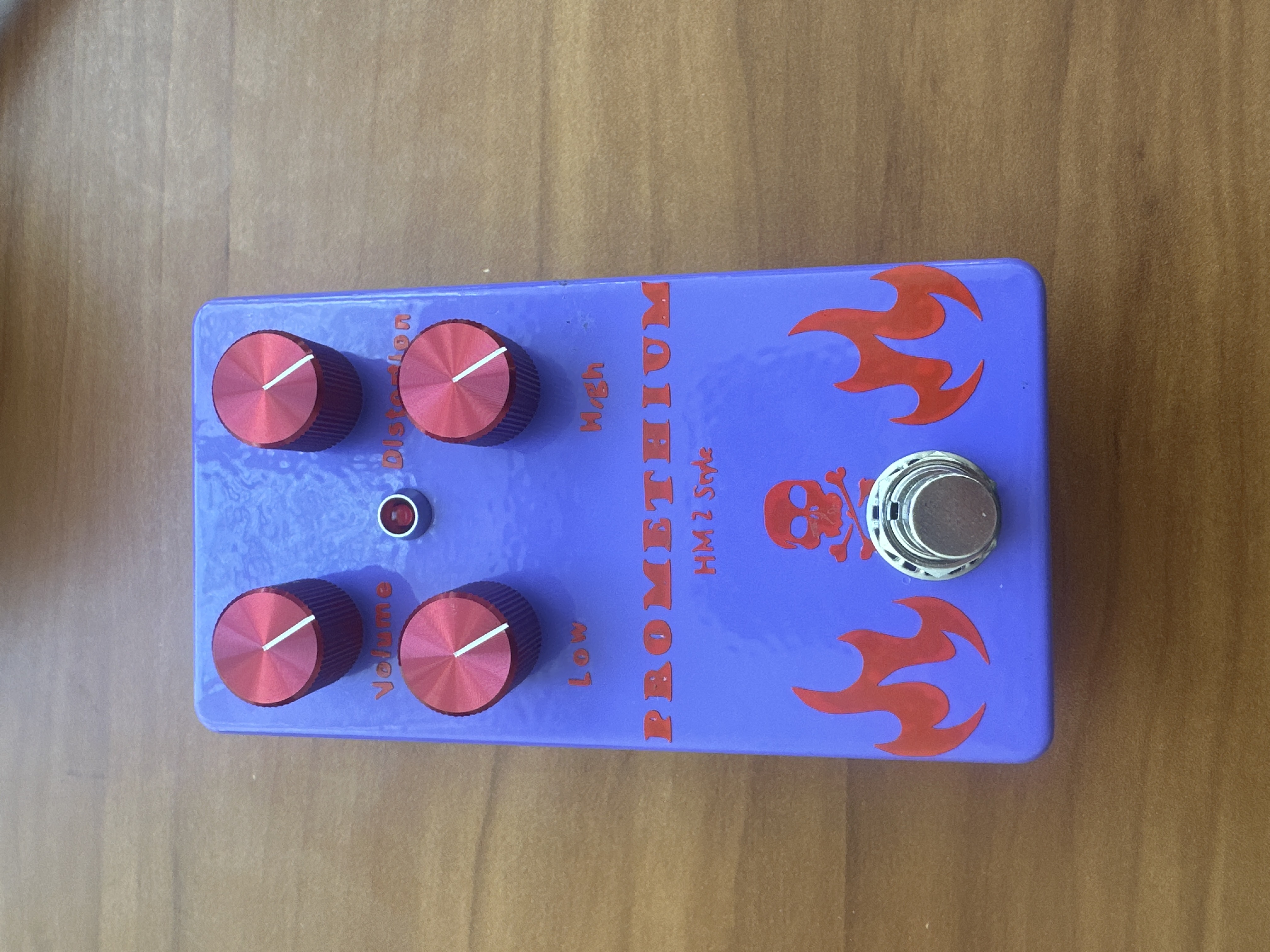
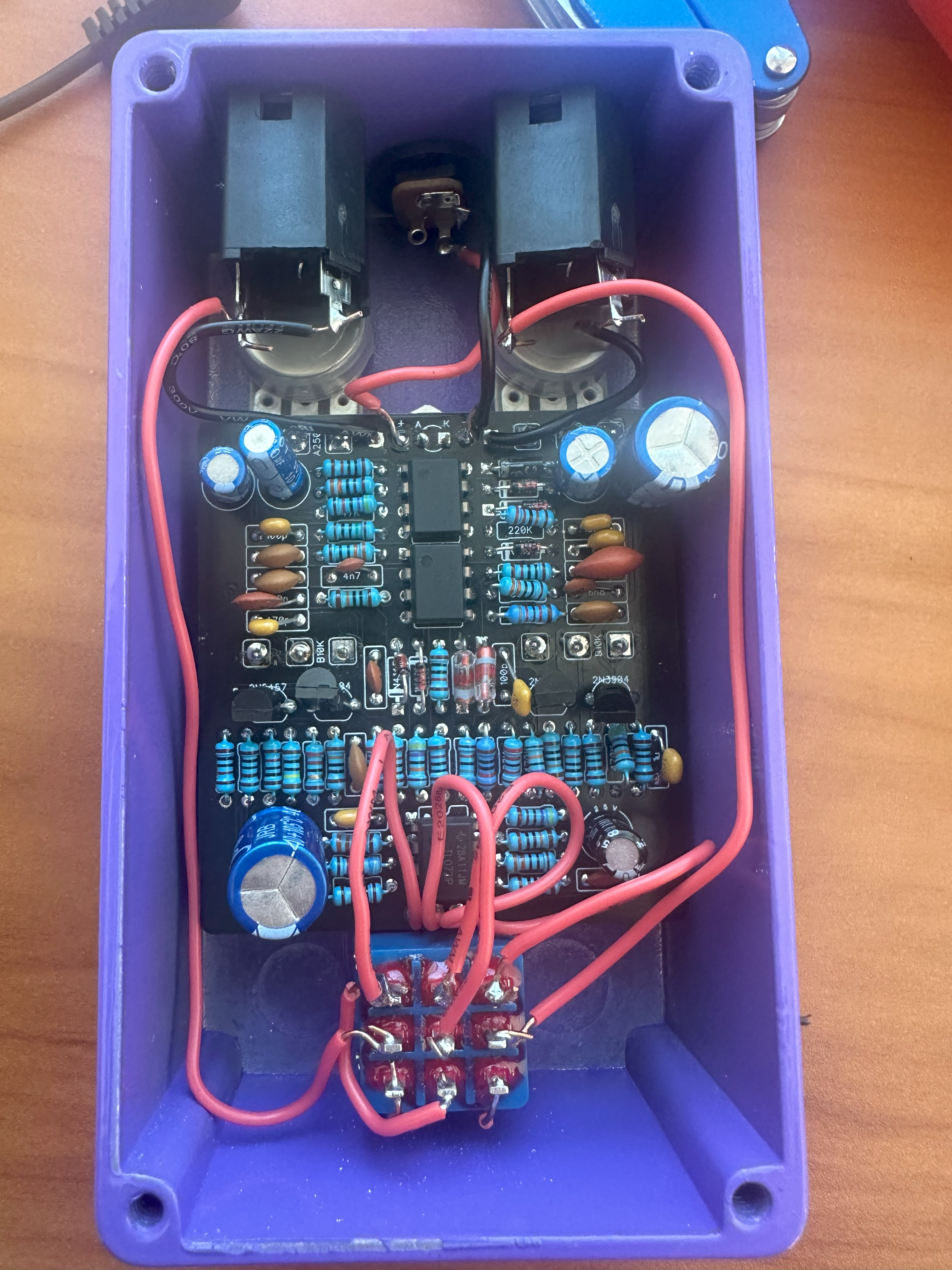
<p>Everything is done! All that was left was to slap the sticker on, attach the knobs, and close it up.</p>

<p><img src="/photos/hm-2/finished-front.JPG" alt="Front" /></p>

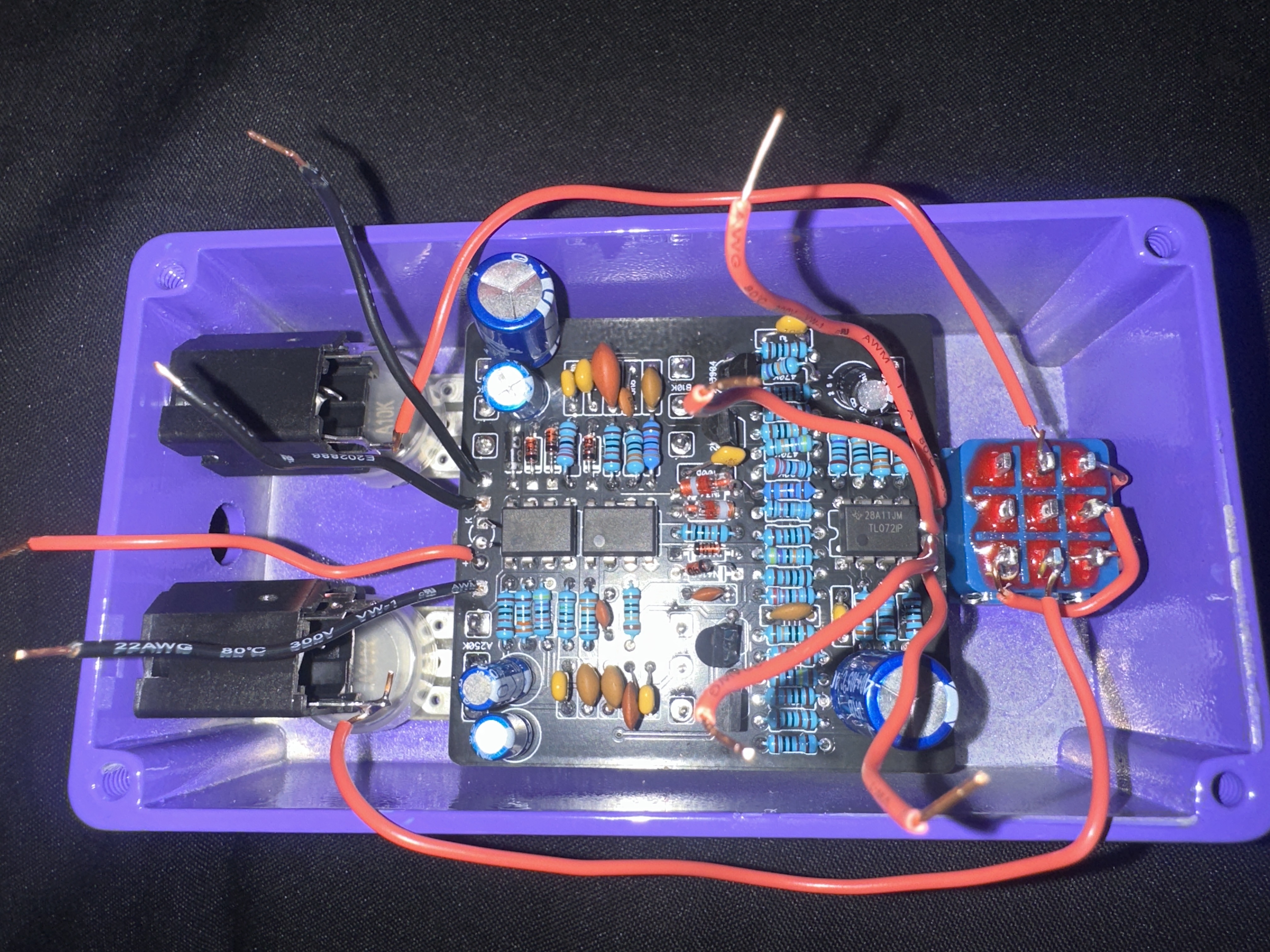
<p><img src="/photos/hm-2/finished-guts.png" alt="Internals" /></p>

<h2 id="lessons">Lessons</h2>
<ol>
  <li>Measure twice cut once.</li>
  <li>Triple check the measurements. Then check them again.</li>
  <li>Short potentiometer legs is what you want.</li>
  <li>I’m not sure exactly which capacitors I’m supposed to get, but get film ones and check the measurements next time.</li>
  <li>PedalPCB’s polarity is wrong. I’m really glad I didn’t destroy the circuit, and now I know for next time.</li>
</ol>

<h2 id="next-steps">Next steps</h2>
<p>For housing artwork, I want to explore some other options:</p>
<ul>
  <li>Tayda offers UV printing, but buying a subscription to Adobe for one print job seems absurd.</li>
  <li>Etching looks interesting. I have a laser printer, so I can do the toner transfer.</li>
  <li>I think my local maker space has a laser cutter, so I could try laser engraving too.</li>
</ul>

<p>For the next pedal, I’m not sure what I’d do:</p>
<ul>
  <li>I’d like a reverb of some kind. The FV-1 looks interesting.</li>
  <li>I’d also be curious about chorus or phaser pedals.</li>
  <li>There are some other pedals that could be useful – overdrive or Boost</li>
</ul>

<p>And, of course, learn some more HM-2 music!</p>]]></content><author><name></name></author><summary type="html"><![CDATA[Why build an HM-2? After finishing my cover of Supposed to Rot (Original) (My cover):]]></summary></entry><entry><title type="html">Website migration</title><link href="https://ryan-b-amos.com/2024/05/11/migration.html" rel="alternate" type="text/html" title="Website migration" /><published>2024-05-11T16:03:15+00:00</published><updated>2024-05-11T16:03:15+00:00</updated><id>https://ryan-b-amos.com/2024/05/11/migration</id><content type="html" xml:base="https://ryan-b-amos.com/2024/05/11/migration.html"><![CDATA[<p>I’ve moved my website from a static HTML site to a Jekyll blog. We’re still hosted on Github Pages. I’ve had some ideas kicking around in my head for things to write about, and I’m hopeful that setting up easier blog posting will help with that.</p>]]></content><author><name></name></author><summary type="html"><![CDATA[I’ve moved my website from a static HTML site to a Jekyll blog. We’re still hosted on Github Pages. I’ve had some ideas kicking around in my head for things to write about, and I’m hopeful that setting up easier blog posting will help with that.]]></summary></entry></feed>